Monday, August 24, 2015

Tips and Products for Early Breastfeeding

Smiling with a belly full of mama's milk.
August is Breastfeeding Awareness Month, which is very fitting since I've started my second breastfeeding journey in the month of August.  There are a lot of fancy gadgets out there that can easily confuse and overwhelm a new mom.  Breastfeeding can be very tough in the beginning, especially for first time moms, so I'm hoping these tips make things a little easier for you.

I'm a very frugal person and hate spending money on gadgets that will just clutter my home.  A lot of my recommendations are things that you find around your house that can be used to make nursing easier.  They do make gadgets that also do these things but why spend money on some fancy tool when something you have in your bathroom cabinet works just as well.


Perfect water cup to use while breastfeeding

  1. Cup:  When you are breastfeeding you need to drink a lot of liquids.  While you are nursing you'll get incredibly thirsty, and since you're using one arm to hold your baby it's a little difficult to drink.  You can use any cup for this of course, but I love this cup my sister-in-law gave me.  The handle makes it really easy to hold and the lid and straw prevent me from spilling while drinking.
  2. Hair Tie:  When I'm nursing I always forget what side I nursed on last.  This causes a problem when I accidentally nurse on the same side a few too many times and realize that the other side is engorged and my baby is full.  I can always pump but I hate pumping when I don't have to, and the side that is being neglected doesn't get stimulated as much as the side that's receiving more attention.  For this reason I use a hair tie. I put the hair tie on the wrist that's the side I've already nursed from.  It's really easy to slip on and off and helps me keep track.
  3. Alarm Clock:  They make fancy apps to help you remember what side you nursed on last and
    what time you nursed last. Instead of downloading another app I just use my alarm clock on my phone.  After I nurse I set the alarm for 2 hours later and when it goes off I know it's time to feed again.  Sometimes Alice cluster feeds and nurses every 1/2 hour to an hour but other times she gets really sleepy and needs to be woken up at the 2 hour mark to feed.  The alarm clock is nice because I don't have to keep checking it, it reminds me when it's time to feed again.
  4. Nursing Pads: When you first start nursing you will become engorged and have a lot of milk. When you nurse and have your milk let-down you will leak on the side you're not nursing.  A lot of moms say this only happens for the first few weeks.  I have a really strong milk let-down so this happens to me for a few months.  In order to not leak all over your bra and shirt you use nursing pads.  There are disposable and reusable nursing pads.  I have a sensitivity to plastics and latex so when I've used the disposable pads my skin has become really irritated.  For that reason I use the reusable pads (and it's less waste, always a plus).  I bought these organic cotton pads and although they're very soft and comfortable, they leak through very quickly, so I haven't been too happy with them.  I have also used the Avent nursing pads and although they don't leak they aren't very soft and they are really thick so if you wear a tight shirt you can see them through the shirt.  Bamboobies are AMAZING! They're super thin, really soft, incredibly absorbent, and DO NOT LEAK.  The drawbacks are that they're shaped like hearts which I've found kind of awkward and they are really expnsive.  I've realized that in the nursing pad game you get what you pay for, so it's your call.
  5. Nipple Butter: When you first start nursing your nipples may become cracked and mine often get scabs.  There are a lot of products out there that can soothe this painful transition your body goes through.  I use the Lansinoh brand but there is also one made by Earth Mama Angel Baby.  I love the Earth Mama products and will definitely try it with my next baby.  When I was pregnant with Ethan I went to a lactation class and the lactation consultant gave me
    the Lansinoh brand, since it worked really well. Because I already had it, it's what I've been using with Alice (be aware that Lansinoh has lanolin in it which makes the reusable nursing pads less absorbent).  There are a lot of options out there though so follow the link and see which brand you think would fit your needs.
  6. Nursing Bra: I've talked about my frustrations with the lack of small sizes in nursing bras, in my post Goldilocks and the Nursing Bras.  Unfortunately, I still haven't found a solution to this problem but I'll let you know what I found works.  I have found the most comfortable and supportive nursing bra to be the Elle Macpherson Nursing Bra.  Sadly, no one told Elle that not all nursing moms have large breasts, so the smallest their bras come in is a 32C.  I use the Elle bras in the beginning when I'm the biggest.  Make sure you buy 1 bra that is 1-2 sizes larger than the size you are at the end of your pregnancy, just so you have something to wear in the beginning.  Once Ethan hit the 5 month mark my breasts went down to a B and eventually even an A cup.  When this happened I found that Target was the only store that carried nursing bras that were small enough for me.
  7. Nursing Cami: With Ethan I didn't think I needed nursing camis, I just used my own spaghetti strap shirts and would pull them down.  I found that this stretches out my shirts and isn't very comfortable.  A friend gave me some hand-me-down nursing camis and it's been so much easier.  I recently purchased these from Target and I really like them but the first two buttons come undone.  I also purchased the Basics Felicity cami and I LOVE them.  
For all my nursing moms out there, were there any tips and products that you found helpful when first nursing?

I've had quite a few moms ask me about drinking alcohol while breastfeeding. Since there are already so many good posts out there answering this question, I'm just going to include the link to KellyMom.com: http://kellymom.com/bf/can-i-breastfeed/lifestyle/alcohol/ All of the info you would need is in their article.

I am by no means an expert in breastfeeding but I hope that you find my suggestions helpful as you embark upon your nursing journey.  As always if you want to message me for support or if you have questions about anything I mentioned in my post please feel free to e-mail me or follow me on Facebook and send me a message (all links are in the upper right hand corner of my blog).  Good luck mama, happy nursing!


*I was not compensated for this post.  These are products that I love, have purchased, and wanted to share with my readers.

Thursday, June 4, 2015

Pumping Journey Part 3: Bottle Feeding a Breastfed Baby

These are the bottles
we used with Ethan.
*I am not a lactation consultant or medical expert; everything that I share about breastfeeding comes from my experience, and personal research.  Please feel free to pick and choose what you think will work best for you and your baby, and good luck mama!

I had already given some information about introducing a bottle to a breastfed baby in my Pumping Journey Part 1 post but there were some details that I didn't add to it so that it wouldn't be too long.  I decided to create a post just for bottle feeding so that all of the information is in one spot.

Tips for Bottle Feeding a Breastfed Baby:

  • The ideal time to introduce the bottle is between 4 weeks to a month.  They also say it is fine to introduce the bottle once a strong nursing relationship has been established.  I introduced the bottle to Ethan at 3 weeks because our nursing relationship got off to a really good start.
  • When first introducing a bottle have someone other than you (the mom) give the baby a bottle.  Even when Ethan was 5 months old he would refuse to take a bottle from me.
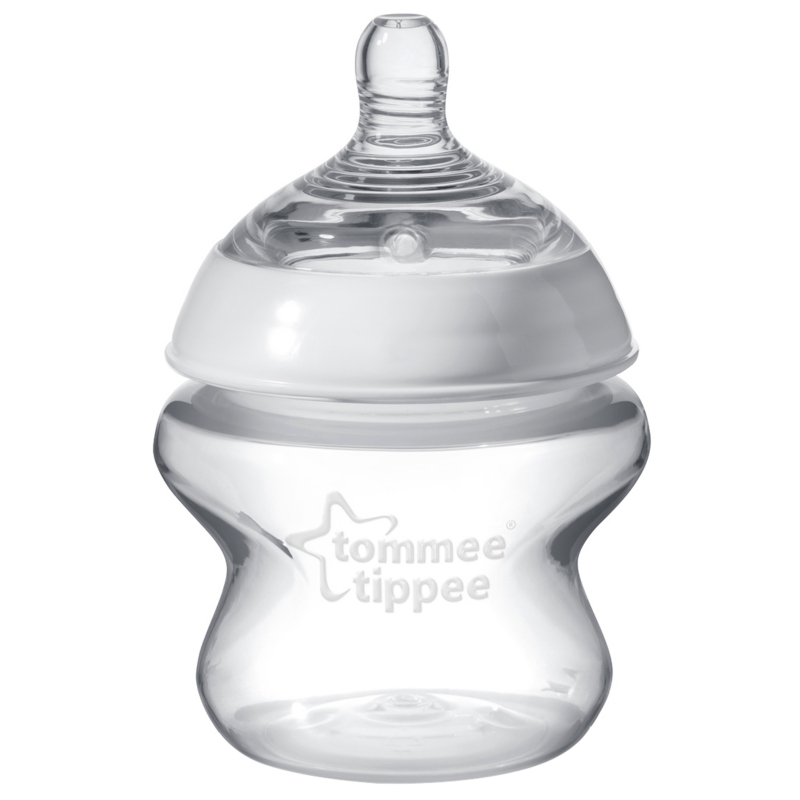
  • We really liked the Tommee Tippe slow flow 0m+ bottles.  They say that it is best to give a breastfed baby a slow flow nipple.  They have faster flows for older babies but I just used the slow flow 0m+ the entire time Ethan was drinking a bottle.
  • Depending on your baby you may have to set up a feeding schedule so that you know how much milk to leave.  At first it may be a little rocky because when I was nursing Ethan we weren't on a schedule, but after a week he settled into a rhythm (we actually used his cues to create the schedule).  He would get a 5 oz. bottle of breast milk every two hours starting at 8 am until 2 pm (I would nurse him at 4 pm).
  • When I first went back to work even though Ethan didn't mind the bottle he did have times when he would refuse it and throw a fit.  Luckily my mom was taking care of him at the time, so when he would refuse the bottle and cry she would hold him close, sing to him, and just soothe him as best she could.  Once he would calm down she would offer the bottle again, and eventually he would take it.  It will take a lot of love and patience from the baby's caregiver if they run into this.
  • Once I was working for a few months he began to have fits when I would try to nurse him.  He would push me away and become very upset.  I just did the same thing that my mom had done when he had refused the bottle and once he calmed down I would try to nurse him again.  It took a lot of patience but our nursing relationship stayed in tact.
  • Ethan took to the bottle pretty easily while I was home so I only gave him a bottle twice a week.  I have a friend whose baby is having a harder time and she's giving her a bottle a day.  You have to find what works and is best for you and your baby.  Whatever you decide to do just remember that you have to pump what you give your baby.  One of the reasons I only gave Ethan a bottle twice a week was because I had a really hard time pumping, and collecting that small amount of milk was very difficult for me.
  • Once I was working I would leave 20 oz. of milk a day, but often Ethan would finish it all and demand more.  I felt as if I was going crazy.  There was never enough milk but it seemed as if I was always hooked up to my pump.  I finally found out about Paced Bottle Feeding, it's a bottle feeding method that is supposed to mimic the rhythm of breastfeeding so that the baby does not drink too much milk, too fast.  Once we employed this method things changed dramatically.  Ethan was content and the milk I was leaving was the correct amount.  Below is the paced bottle feeding video that I showed to Jeff.

  I also know some babies that never took to the bottle and so their moms gave them a sippy cup instead, or the baby wouldn't drink milk while mom was at work and then would nurse all evening.  Just know that there is no, "Right Way" to do any of this.  Figure out what works for you and your baby and don't worry if it doesn't match what anyone else that you know has done.   

   I know that all of this seems very overwhelming and I'm sorry for that.  Thinking of all of this pumping and bottle feeding stuff was the last thing I wanted to do when bonding with my baby. Unfortunately, I had to return to work, it was not an option for me to stay home.  I know that for many working moms staying home isn't an option; one of the main goals of my blog is to support moms in these kids of situations.  If anyone has questions about any of my blog posts please feel free to ask questions here or to e-mail me.  I'm more than happy to help.  


Tuesday, July 22, 2014

Bittersweet Transition


This is Ethan's one year photo-shoot, shot
by Andmade Photography

I celebrated a big milestone 2 months ago; I breastfed Ethan for an entire year! I know this may not seem like a huge accomplishment, but believe me, there were days where I didn't think we'd make it to the end of the week let alone the end of the year.  Even though I worked full-time I was able to breastfeed or give Ethan breastmilk in a bottle (without supplementing with formula) for an entire year.

As I got to the end of the year I slowly stopped pumping at work.  I had been pumping twice a day (at 9 AM and 12 PM).  I first stopped the 9 AM pumping for a week, and then I stopped the 12 PM pumping the next week.  Unfortunately, stopping the pumping also meant not nursing Ethan anymore during the day.  That's the problem with pumping, since I do it 5 days a week and only nurse Ethan during the day, 2 days a week, once I stopped the pumping I was also stopping the daytime nursing.  

This was a very hard decision for me to make but I got to the point where I felt that I needed to listen to my body and it was telling me that it was time to stop.  My hair had started to fall out again, and I was taking a lot of fenugreek supplement in order to pump a measly 8 oz. a day. Ethan also began to show signs that he was done.  On many occasions when I would go to nurse him he would push me away and want to go play instead.  He has also become a very good eater and would often sign for food instead of milk.  If I would try to nurse him before feeding he would become angry and sometimes even bite me!  I realized that both my body and my son were letting me know that we had had a good run, but it was time for us to stop nursing.  

Ethan let go of the daytime nursing just fine, since he usually drinks his milk from a sippy cup it wasn't a big change for him anyway.  I held onto the evening and before bedtime nursing for a few more weeks but quickly noticed that my supply was almost non-existent, and that Ethan was getting frustrated with the lack of milk.  He would often push me away at night and prefer to be placed in his crib and would go to sleep on his own.

So on the night that was his last nursing I looked down at him and as he nursed I thought about the wonderful journey we had embarked on this last year.  Although it was incredibly difficult to pump it was also the most beautiful experience I could have shared with Ethan.  The bonding that occurred and the gift that I gave to him through our nursing relationship is something that I will treasure forever.  I also said a prayer thanking God for giving me the tenacity to continue on this journey even when things were difficult, and for just making the whole thing possible.  

Monday, May 5, 2014

Pumping Journey Part 2: Pumping at Work

These are the 5 oz. bottles I would pump ino


*I am not a lactation consultant or medical expert; everything that I share about breastfeeding comes from my experience, and personal research.  Please feel free to pick and choose what you think will work best for you and your baby, and good luck mama!

You may be asking yourself, if Luanita's such a breastfeeding advocate why is she writing a series on pumping and not breastfeeding?  The main reason is that when I was breastfeeding I had an overwhelming amount of support, from my mom to lactation consultants, and endless amounts of articles online.  When I went back to work and started pumping it was a very different story.  I didn't know anyone who had worked full-time and given their baby breastmilk only.  Everyone I knew had ended up supplementing with formula, worked part-time, or was a stay at home mom. Like with anything there's a lot of information online, but I still felt very alone on my journey. Although this is also online I would like to invite anyone that needs encouragement or wants to ask questions to send me a message, and I'm happy to help, and I also feel as if it's encouraging for moms to know that there are moms out there working full-time and breastfeeding, and that it is possible.

Top Tips for Pumping at Work 

  1. Drink A LOT of water.  When my pumping was at it's highest I was drinking a gallon of water a day.  I am not exaggerating, I actually added up all of the ounces of water that I was drinking and it was a gallon.
  2. Do not go more than 3 hours without pumping.  When I first started I was pumping every 4 hours, to save time at work, and I ended up with clogged milk ducts (which are incredibly painful).  By the time I went to the doctor I was on the verge of an infection and she said that I could not go more than 3 hours without pumping.  Every woman's body is different so yours may not be as susceptible to the clogged ducts, but consult with your physician on this matter.  If you do not pump often enough, you not only risk infection, you also risk lowering your milk supply.  Remember that milk production is all about supply and demand.  So if you go from nursing your baby every 2 hours, to only pumping every 4 hours your body will think that the baby doesn't need as much milk anymore, and will stop producing the amount that you need for your baby's bottle feedings.  Just in case you are worried about your employer, know that there are laws that protect working mothers who wish to pump.  Follow this link:  http://www.ncsl.org/research/health/breastfeeding-state-laws.aspx for further information.
  3. Have a set schedule for your pumping.  When you are away from your baby your body will not respond the same way, and it may have difficulty letting milk down.  You need to train your body to respond to the pump just as it does your child, and one way to do this is to set a very strict schedule.  When I was at work I would pump at 9:00 AM, 12:00 PM, and 3:00 PM (I also pumped at home but I will mention that in a later post).  If for some reason there was a schedule change and my break was moved, I would talk to my principal to get someone to cover my class. This way I could stay on my schedule because if I did not do this I would develop the clogged milk ducts I discussed earlier.
  4. Stay calm; it is very difficult to pump at work.  You may be worried that someone will walk in on you.  If you become nervous your body will have difficulty letting milk down.  I made a sign that I would put on my door that said DO NOT DISTURB, please return in 15 minutes. 
  5. Look at pictures and videos of your baby.  Especially in the beginning when everything inside of me was telling me that I NEEDED to be with Ethan this was very helpful.
  6. Have a nursing cover with your pump supplies.  I co-teach and therefore share my room with another teacher a few periods a day.  One of those periods is my prep when I would pump.  I told my co-teacher the situation and asked her if she was comfortable with me pumping with a cover on during our prep.  She was very understanding and supportive.  So while we planned and discussed our students I would put my cover on and pump.  It allowed me to get work done with a co-worker, and it still gave me privacy.  Of course it is part of the law that your employer will give you a private space to pump, but because I needed to get work done, if my co-teacher was O.K. with it I preferred being able to pump and plan with her at the same time. 
  7. Have an extra set of tubing, breastshield, valve, membrane, and 2 bottles that you keep at
    breastshield, valve, and membrane
    work at all times.  When I first started pumping I kept reading to do this and I thought to myself, please, without that I can't pump, of course I'm not going to forget it.  Well, the first time I opened my pump and realized i'd forgotten to pack my pump supplies because I was in a hurry I felt my heart drop.  Poor Jeff had to drive 40 minutes to my work to bring me the stuff.  So then I thought, OK, I've done it once, I won't do it again, WRONG! So after the second time I bought an extra set of everything and I always leave it in my classroom. This extra set is also good in case any of your parts get damaged and you don't realize it until you get to work (this actually happened to me today, and my extra set saved the day).
  8. Eat well balanced hearty meals.  On the days that I would eat meals packed with protein, carbohydrates, and a good serving of vegetables I definitely noticed a huge increase in my milk production.  After having a baby it's tempting to eat small amounts or diet to loose that baby weight, but your body needs all of the nutrition and callories it can get to make milk.  I've read that a woman's body can burn 600-700 calories a day by breastfeeding, so eat up mama!

There is so much information out there it can be overwhelming.  I've listed the things that really worked for me but if these things haven't worked for you, or you just want to know everything you can so that you can try as many things as possible try visiting the link below.

Thursday, April 17, 2014

Pumping Journey Part 1: Before Returning to Work

An image and slogan I constantly
 repeat to myself as my pumping
 journey continues.

*I am not a lactation consultant or medical expert; everything that I share about breastfeeding comes from my experience, and personal research.  Please feel free to pick and choose what you think will work best for you and your baby, and good luck mama!

My Nursing Journey
There was one big reason that I wanted to start writing this blog.  When I first found out I was pregnant there were two things I wanted to do with fidelity, exclusively feed my baby breastmilk (no formula supplementing), and use cloth diapers (that's a story for another post).  Everyone has their own philosophy about breastmilk vs. formula but that's not what my posts are going to be about.  Aside from my philosophy, I knew that I wanted my child to be raised on breastmilk, and I was willing to do whatever it took for that to happen.

When I was pregnant I took a lactation class that taught baby led latching.  If you're an expecting mom that plans on breastfeeding, I highly recommend taking a lactation class while pregnant.  I really felt as if this class gave me some key tips, and I loved the baby led latching method.

Then Ethan was born and my nursing story was one of pure bliss, yes I had the cracked nipples, clogged milk ducts, engorgement, and stress before my milk came in, but with the knowledge from my lactation class and a lot of support from Jeff, my mom, Ethan's pediatrician, and the hospital's lactation nurses, mine and Ethan's nursing relationship got off to a great start, and has been wonderful ever since.  I felt as if I was on cloud nine, I had heard all of these horror stories about nursing, and I felt truly blessed to not have experienced anything out of the ordinary.

Preparing to go Back to Work
If you are planning on going back to work and pumping there are some very important things you must do while at home to prepare.

Tommee Tippee Bottles


  1. Introducing a bottle
  • There is a very small window for introducing a bottle to a breastfed baby, they say that the ideal time is between 4 weeks to a month (I told you it was small).  I had heard horror stories from friends who had waited too long and their baby had rejected the bottle, but they still had to go back to work.  This scenario completely terrified me.
  • When doing further research, everything I saw said that as long as your baby was latching properly, you were producing plenty of milk, and yours and your babies nursing relationship had been fully established, you could introduce a bottle as early as 3 weeks.  Since our nursing relationship was very well established, as well as my milk supply, I began giving Ethan a bottle towards the end of 3 weeks.
  • We used the Tommee Tippee slow flow bottles and have loved them.
  • I would only give him a bottle 2 times a week with 2 ounces of milk.  He would usually drink the most at night, so that's when Jeff would give him the bottle. We would always leave him hungry so that he would nurse afterward.  I didn't use the bottle to fill him up because I didn't want to affect my milk supply; I just continually used the bottle so that he would be used to getting his milk from my breast and the bottle.
  • I continued to use this schedule until I returned to work.
The Medela Pump in Style Kit

   2. Pumping

In order to start giving Ethan a bottle I needed to start using my pump so that I would have breastmilk to give him.  Previous to pumping I had watched a show where a mom was going back to work.  The morning before she went back to work she pumped all the milk her baby would need for the day, and proudly left the house.  With this image in my mind I thought, cool, no big deal.  Imagine my horror when I started pumping and it was incredibly painful, and after 15 minutes of pumping I had gathered 1/2 oz. of milk. Just to put things into perspective, once I was back at work I would leave Ethan about 25 oz. of milk a day (I've heard this amount is very high, but my little guy is an eater).  I was horrified, and had no idea what was wrong with me.  How on earth was I ever going to pump enough milk for my baby?  Every time I would pump, my session would end in tears. I finally reached out to my good friend Katie, who was a doula and is very knowledgeable when it comes to nursing.  With her help I was able to figure out what was wrong, and what was normal, and I got my pumping on track.
Breastshield
  • My first problem was that I was using the wrong size breastshield.  I was using the one that came with the pump but I was a size smaller.  This is why pumping had been so painful.
  • The second issue wasn't even an issue at all, when you first start pumping it is completely normal to only pump 1/2 an ounce because your baby is taking a lot of the milk, and your body isn't used to letting your milk down for the pump.  This is also why you should start pumping before you return to work, so that your body is used to the pump.  Once I realized this I relaxed and would pump a couple of times a day.  As soon as I had gathered 2 oz. (it would usually take me 2 days), I would give them to Ethan and continue pumping for the next bottle feeding.
  • One thing that is very important to take note of is to only pump when you know your baby is taking a long break from nursing.  I would pump during his long midday nap, and at night, after he had gone to sleep.  You do this for two reasons: first you don't want the pump taking the milk that your baby will be needing, and second you want to wait a little while after your baby nurses so that your body makes more milk.
  • Once my milk supply was established I began to pump about 4 ounces per pumping session.  This allowed me to give Ethan his 2 ounces twice a week and to freeze the extra milk.
  • I love the Lansinoh breastmilk
    freezer storage bags
  • It is very important that once you have extra milk you begin to freeze the milk in increments of at least 5 oz.  When I went back to work I had frozen about 30 bags of breastmilk which was approximately 180 oz. of milk.  This is a crucial step in the pumping and working scenario.  At times your milk supply will drop for various reasons, and the only way you will have enough milk for your baby is to dip into your freezer stash.  On days where I also had to work late and would have to leave more milk than usual I would use a frozen bag.  This freezer supply has been one of the big reasons why I believe I have not needed to supplement with formula.

I'm sorry this post has been so long, there is so much information that goes along with my journey that it's difficult to condense it.  Although Ethan is 11 months and I've been doing this since he was 3 weeks old the idea of having to write all of this down is the main reason why I've held off for so long.  Writing this series is really special to me because although this has been one of the most difficult things I've ever done, it has also been the most rewarding accomplishment.  

Friday, March 14, 2014

Goldilocks and the Nursing Bras

This picture captures how I felt every time I'd look for a nursing bra.
When I became a teenager one of the things I looked forward to the most was getting the breasts that I'd been promised as a young girl.  I patiently waited and wore my training bras, while dreaming of the day that my breasts would magically arrive.  Well, years went by and I continued to buy my bras in the training bra section.  At 22 I realized that my delivery had come in a very small package.  When talking to my mom about how bad it felt, to be 24 years old and have the body of an 11 year old, she said, "Don't worry Mija, when you have your babies and breastfeed the milk will give you bigger breasts".  So I thought, O.K., it's better than nothing.

Once I was pregnant I once again began waiting for the larger package that i'd been told would arrive. As the months passed and I continued to wear my A bras I began to have deja vu.  Apparently, not all women grow larger breasts when they're pregnant, and of course I was one of them.  Once again I was told, don't worry once the baby comes and you're nursing they will come.

Ethan was born, I started nursing, and they finally came!  It was more wonderful than I could have imagined, the breasts I'd been waiting for since I was 12 years old had finally arrived.  After a few months of nursing, my milk supply normalized, and I started to notice that my breasts were getting smaller and smaller.  The reason I'm telling you this long embarrassing story is to let you know that the issues of bras and breast size have been something that I've struggled with for a long time.  I thought that once I was nursing I would finally be able to find bras that fit.

Prior to having Ethan I had bought some C sized nursing bras because I had no idea what size I was going to be.  They fit fairly well in the beginning.  As time went on the Goldilocks dilemma began to rear it's ugly head.  All of the bras I had bought were too big for me by the time Ethan was 4 months. So I went in search of comfortable, good fitting bras.

What I found truly disappointed me.  It turns out that most nursing bra manufacturers think that if you're nursing you must have extremely large breasts because I was unable to find bras that were smaller than a C cup.

I first bought the Elle Macpherson nursing bra.  The smallest size it came in was a 34C; I thought, since that's the smallest they come that must be my size.  It was fairly comfortable but the more I wore it the more I realized it was too big.  Having nothing else though, I continued to wear it.  Some positives on this bra (if they do carry your size) is that they're very pretty, the material is soft and comfortable, and if they sold my size I think I would have really liked it.
Elle Macpherson bra
I also bought a Cake sports bra in a size small.  It's supportive and comfortable and I'd highly recommend it if you're looking for a sports nursing bra, but I couldn't just wear a sports bra every day.
Cake nursing bra
I had my cousin Marianna measure me (she works at Victoria's Secret), and it turns out i'm a 32B. Take note nursing bra companies, NOT ALL WOMEN WHO NURSE HAVE LARGE BREASTS!  In case you're wondering I nurse/pump exclusively, so I am producing a lot of milk, I just do it without having a large chest.  At this point, after buying the first set of bras and then these two bras, I had spent over 200 dollars on bras that didn't fit.  I started researching online to see what the best bras for small breasted nursing mamas were, and all around the web mamas were complaining.  A lot of them said they just used tank tops with built in bras, but since I work full time and need to dress professionally for work, that was not an option I felt comfortable with.

One day, while I was browsing the aisles of Target I found their nursing bra section.  Lo and behold they had small nursing bras! I bought 3 and have been very happy with the sizing.  They fit my 32B breasts very well and are comfortable.  The downside is that they don't give me much shape and tend to flatten me out, it kind of looks like i'm wearing a sports bra, but at this point i'll take what I can get.  A side note for new mamas when buying nursing bras, do not buy bras with underwire.  They can cause clogged milk ducts, and after having my fair share of those, trust me when I say it's much better to have the sports bra look than golf ball sized lumps in your breasts.
Gilligan & O'Malley Nursing bra I bought the skin tone and
black with polka dot one.  They also have a grey one.


I just bought this Gilligan & O'Malley bra today and am excited
about the fact that it has built in cups.  Hopefully it will fix
the sports bra look of the other two.


Basics by Bravado! Stella nursing bra.  This one is very comfortable and I love
sleeping in it.  The one downside is that the elastic bands that connect the
straps to the bra have stretched out and are now very loose.


After finding dozens of way too big bras I have finally found my just right bras.  Thank you Gilligan & O'Malley and Basics for realizing that mamas come in all shapes and sizes, and even us small mamas need bras.
 
Design by: The Blog Decorator